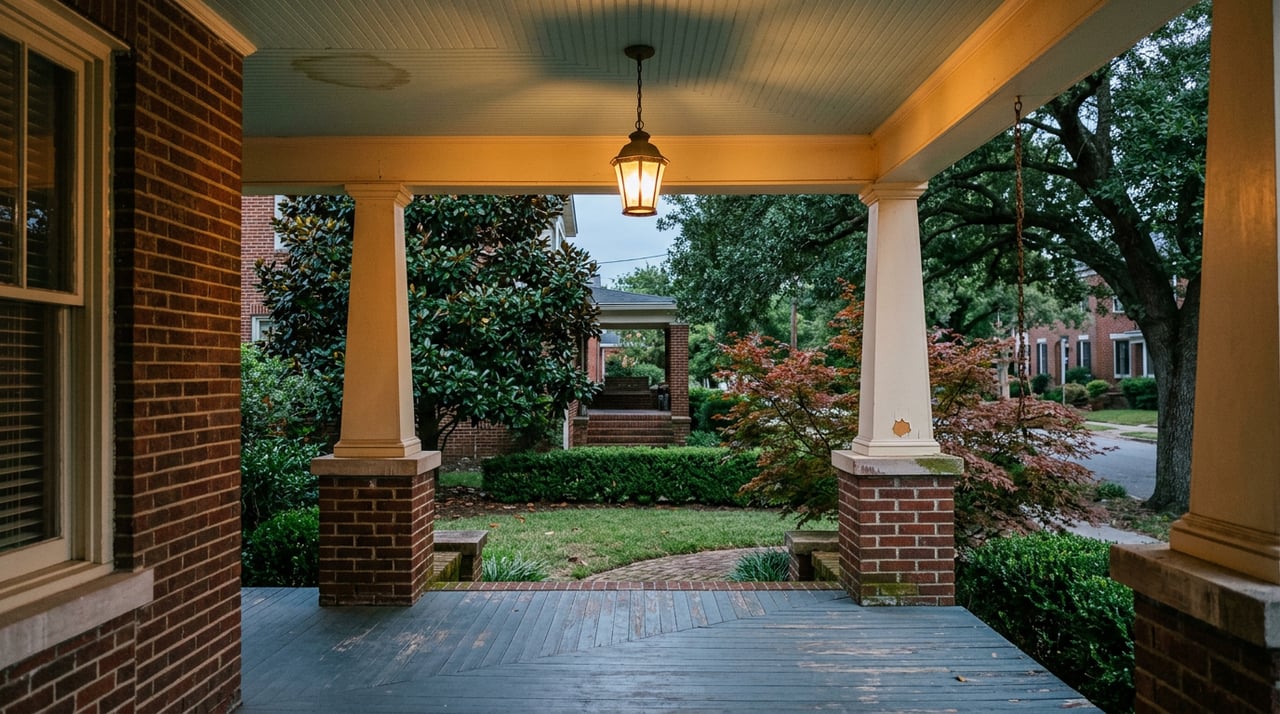
On a clear evening with temperatures sitting in the mid-70s, Jerry and Michelle Baus opened their Swiss Avenue terrace to neighbors from across the Swiss Avenue Historic District. Cocktails replaced clipboards, and the talk turned from architecture to who was hosting next. The neighborhood association billed it as the official return of the pop-up porch party, a tradition that had gone quiet for years. That single detail, official return, is the tell. Nobody schedules a comeback for something that never mattered.
The porch party isn't a one-off. It's the fall half of a rhythm that Old East Dallas runs every year, and understanding that rhythm tells you more about how this neighborhood actually works than any listing description ever will.
A Neighborhood Built From Separate Small Districts
Old East Dallas isn't a single HOA with one set of rules. It's a cluster of separately governed historic districts, each with its own boundaries, its own ordinance, and its own reasons to guard its identity. Munger Place runs roughly between North Fitzhugh, Gaston, Henderson, and Columbia avenues, a footprint that holds over 250 households and the largest collection of Prairie-style homes in the country. Swiss Avenue, just north of it, became Dallas's first designated historic district in 1973 and landed on the National Register the following year. Peak's Addition traces back to 1855, roughly fifty years before Munger Place and Swiss Avenue were platted, and its 22 blocks still hold a mix of Victorian, Craftsman, Georgian, and Art Deco houses from that earlier era.
Each of these districts operates under its own Certificate of Appropriateness process, its own volunteer board, its own preservation fights. That fragmentation is a real cost. A few hundred households in Munger Place can't do much lobbying alone. A neighborhood association covering 22 blocks in Peak's Addition doesn't have the numbers to keep a tradition alive on its own either. So residents built a second layer that sits above the individual districts, something that functions less like a homeowners' meeting and more like an alliance.
The Picnic That Exists Because Nobody Wanted To Compete Alone
That alliance shows up every spring at the East Dallas Games and Picnic, held this year on April 25 at Buckner (Samuell) Park, a 9.3-acre neighborhood park established in 1914 and one of the few green spaces large enough to hold every district's team at once. The organizers are explicit about the point of the event: to build camaraderie among neighborhoods that face similar opportunities and challenges, on the theory that they're stronger together than any one district would be alone.
This year the Swiss Avenue Historic District fielded its first competitive team, and it did not embarrass itself. Gold in the Balloon Toss. Silver in the Sponge Bucket Relay. City council members Paul Ridley and Jesse Moreno showed up to watch, Moreno's daughter Ava among the spectators. None of that is a footnote. It's evidence that the picnic has enough institutional weight to draw the people who actually vote on the ordinances these districts live under.
The picnic is the one afternoon a year when separate boards stop acting like separate boards.
That's the mechanism worth naming. The Games aren't a novelty event bolted onto a historic neighborhood's calendar. They're the connective tissue that keeps districts too small to act alone from drifting apart entirely.
Why The Porches Reopen After The Games End
Once the picnic wraps in spring, the energy doesn't disappear. It migrates into a smaller, more intimate format: the porch circuit. Swiss Avenue's revival of pop-up porch parties, capped off by the Bauses' terrace gathering, works the same logic at a household scale. Where the Games pull in every district and a couple of council members, the porch party pulls in the block. It's lower stakes and higher frequency, and it's the format that actually sustains relationships between picnics.
Munger Place runs its own version of this same instinct year-round through its Porch of the Month recognition and quarterly General Sessions, small rituals that keep a 250-household district talking to itself between the annual home tour and art festival. None of these traditions would survive if they were left to a citywide events calendar. They survive because they're sized to the neighborhood that runs them.
The Restaurant That Finally Gave The Circuit A Fixed Address
For years, Old East Dallas residents drove to Lower Greenville or Deep Ellum for a destination dinner because the neighborhood itself didn't have one. That changed in May 2026, when chef Olivia López and her partner Jonathan Percival opened Olōyō at 4422 Gaston Avenue, inside the neighborhood's boundaries and a short walk from both Munger Place and Swiss Avenue. López spent years building a following through weekend pop-ups under the Molino Olōyō name before landing the brick-and-mortar in the old Cry Wolf space, and the restaurant has already picked up a James Beard nomination.
What matters for the neighborhood isn't the accolade. It's the address. A neighborhood built from separately governed pieces finally has one place that sits inside all of their walking radii, a shared table for a district that had been meeting on porches and picnic blankets because it didn't have anywhere else.
The Regulars That Already Do The Work
Olōyō is new, but it's joining a rotation that residents have leaned on for years to keep the same kind of informal, cross-district socializing going:
- Garden Cafe on Junius Street, a farm-to-table spot with a garden setting that draws from both Munger Place and Swiss Avenue.
- Lakewood Landing on Live Oak Street, a dive-bar standby for the burger-and-a-beer crowd that doesn't want a reservation.
- AllGood Cafe on Main Street, Southern comfort food with live music that pulls people east from Deep Ellum's edge.
- Pie Tap Pizza Workshop and Bar on North Henderson Avenue, a wood-fired option that sits close enough to Munger Place to be a weeknight habit rather than an event.
None of these are marketed as neighborhood anchors. They function as one anyway, because they're the places where residents from different districts end up at the same bar without planning it.
The Pattern Underneath All Of It
Take the Games, the porches, and the restaurant together and a single thread runs through all three: Old East Dallas doesn't hold itself together through size. It holds together through repetition. A picnic every spring. A porch circuit in the fall. A handful of restaurants that everyone ends up at regardless of which historic ordinance governs their block. Small, separately governed districts that couldn't sustain much on their own found a way to act like one neighborhood without giving up what makes each district distinct.
If you already live here, that explains why the calendar feels the way it does. The next porch party host hasn't been announced yet, and in a neighborhood this size, that's usually decided by whoever shows up next.
If you're weighing a move within Old East Dallas or want a clearer read on how these districts differ block by block, Hewitt+Saucedo has spent years inside these boundaries and can walk you through what each one actually offers.